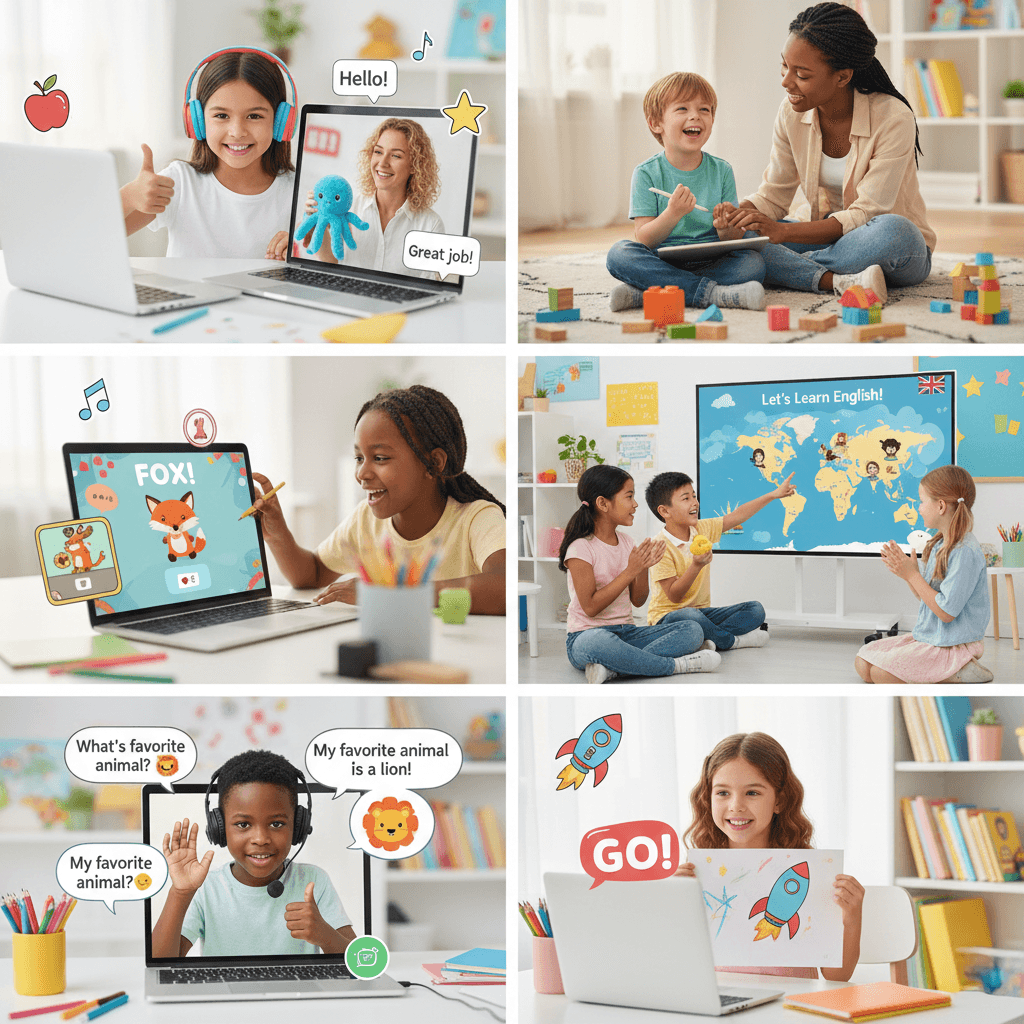
For parents accustomed to traditional education methods, "learning a language in front of a screen" may initially raise doubts. However, modern educational technologies (EdTech) show that a well-designed online platform yields results much faster than physical classrooms.
1. Maximum Student Talk Time (STT)
If there are 15 students in a class, each child can only speak for a few minutes in a one-hour lesson. In online one-on-one education, 100% of the lesson belongs to the child.More speaking practice = Faster fluency.
2. Pedagogical Gamification
Children learn best when they don't realize they are "learning." Online platforms trigger the brain's reward mechanism by enriching visual and auditory stimuli. Thus, the child sees the lesson as an activity rather than a homework task.
3. Tutor Quality and Diversity
In face-to-face courses, you are limited to the teachers in your local area. In online education, you can choose from the world's best "native" tutors from New York to London, Sydney to Toronto. Hearing different accents maximizes the child's auditory familiarity and comprehension skills.
"Research shows that language education supported by interactive digital tools provides 30% faster retention compared to traditional methods."
4. Overcoming Fear (Safe Zone)
Many children hesitate to speak in front of their friends in class. A child who is alone with their teacher in the comfort of home is not afraid to make mistakes. This area of freedom rapidly breaks down the "speaking barrier," which is the biggest obstacle to language development.